Editorial update · Updated October 19, 2026. This page has been rewritten; historical models and events are identified in the text.
The federal side-impact standard gives applicable child restraints a common performance requirement for a defined laboratory test. It is useful progress, but it does not turn every seat into a ranked product or answer every question about real-world fit. Families need to distinguish the standard’s current timetable, its scope and the claims a manufacturer makes about a particular model.
The compliance date changed
NHTSA established FMVSS No. 213a in 2022. The original June 30, 2025 compliance deadline is no longer the current deadline. A final rule published September 9, 2026 moved mandatory compliance to December 5, 2026. The amendments became effective October 9, 2026. Those are different dates: the effective date of an amendment is not necessarily the date every covered newly manufactured restraint must comply.
The September 2026 rule also revised provisions concerning school-bus restraints and test-dummy selection and positioning. In particular, the CRABI twelve-month-old dummy is no longer used for forward-facing testing. Reading only the original 2022 announcement can therefore give an incomplete picture of the requirements.
Keep 213a and 213b separate
FMVSS 213a addresses side-impact protection. FMVSS 213b updates the broader child-restraint standard, including the frontal test environment, and also has mandatory applicability beginning December 5, 2026. Similar names and the shared date do not make them the same test.
When a manufacturer says a product meets a “new standard,” ask which standard, which production version and which modes the statement covers. A model family can change while retaining a familiar name. The manufacturing label, matching manual and manufacturer’s confirmation are more useful than assuming an old review describes the unit on the shelf.
Which restraints fall within the side-impact rule?
The rule’s scope uses the child sizes for which the manufacturer recommends the restraint. It covers applicable add-on restraints whose recommended range includes children up to 18 kilograms, or whose height range includes children up to 1,100 millimeters, subject to the regulation’s definitions and exclusions. These are scope thresholds, not instructions to move a child to a booster at those measurements.
Car beds, the defined category of harnesses without a rigid seating structure, and qualifying school-bus restraints are excluded. The regulatory use of “harness” here must not be confused with a conventional car seat that contains an internal harness. Similarly, an all-in-one seat’s harness modes and booster mode should not be assumed to have identical test coverage. Read the applicable rules and model information together.
What happens in the laboratory?
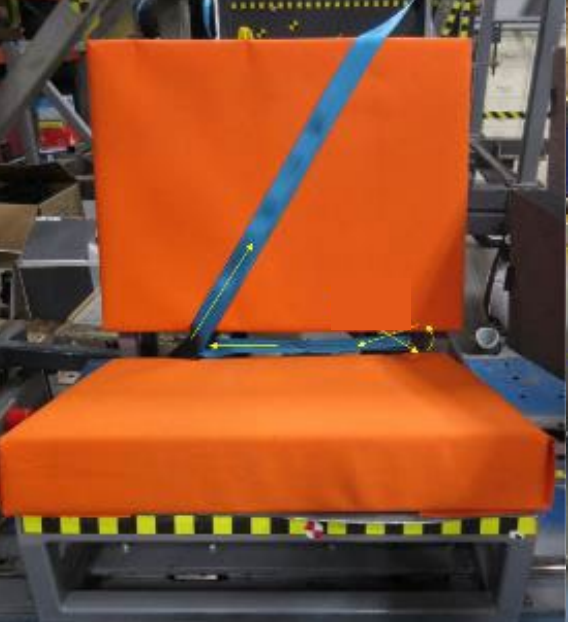
The test uses a standardized side-impact seat assembly with a sliding seat and a simulated door. Relative movement between them represents important aspects of a near-side collision, including intrusion toward the occupant. Defined mounting arrangements, restraint settings and dummy positioning make the procedure more repeatable than an unspecified demonstration video.
The dummy selected depends on the seat’s recommended child-size range and orientation. The standard uses the CRABI twelve-month-old and the Q3s three-year-old side-impact dummy under specified conditions. The names describe test devices; they do not mean that every child of that age has the same body size or should ride in the same restraint mode.
Performance requirements include structural integrity and specified occupant-protection criteria. The Q3s provisions include limits for a calculated head-injury criterion and measured chest deflection. Other provisions address head containment for the smaller-child range. Passing one observation, such as keeping an adjustment in place, does not by itself establish compliance with all applicable requirements.
What a passing result does not establish
A minimum standard is not a five-star comparison of every seat. It sets requirements for the defined test conditions; it does not guarantee that a child will avoid injury in every crash. Actual collisions vary in direction, severity, intrusion and the surrounding vehicle environment.
Nor does the rule prove that a particular shape, thick foam layer or marketing feature is superior. Two seats can meet the same requirement through different designs. A responsible comparison needs comparable test conditions and a clear explanation of what was measured. NHTSA’s ease-of-use ratings answer another question—how readily a caregiver can use a seat correctly—not a ranking of crash protection.
Laboratory procedures also are not installation instructions for families. Do not copy a test fixture’s routing, omit a component because it was absent in a photograph, or add padding to imitate another design. Follow the manual for the product and the vehicle.
What owners and shoppers should do
The new manufacturing requirements do not, by themselves, announce a recall of every earlier seat. Check the actual unit’s certification information, permitted service life, condition and recall status. If a manufacturer changes the limits or instructions for a newer version, do not apply those changes to an older unit without confirmation that they also cover it.
For a new purchase, ask whether the exact model and production version meet the applicable standards, then evaluate child fit, vehicle compatibility and ease of everyday use. An attractive compliance claim does not compensate for an installation the caregiver cannot perform correctly. Register the restraint so later notices can reach you.
Continue with how to interpret public crash-test information, the car-seat selection guide and the everyday restraint checklist. For technical work, use the current rule text and NHTSA test procedure linked below; they contain definitions and exceptions that a consumer summary cannot fully reproduce.