A few years back, a friend of mine in Largo had artificial grass put in her backyard, mainly for her two Labs. It looked great for about a month. Then summer came, the afternoon storms started blowing in off the Gulf, and a sour smell started rising from the corner the dogs always used. The grass itself held up fine. Her trouble came from the product she’d picked and how it was put down, with a backing that drained slowly, a thin base laid over sand and an infill that did nothing about odor.
She tore it out and redid it, this time with turf made for dogs and an installer who asked far more questions. The second yard has given her no trouble. What happened to her happens a lot in Florida, and you can avoid it.
Florida is hard on pet turf
Pet turf has more to deal with here than in most of the country. It’s hot nearly all year, the humidity keeps things damp, the sandy soil shifts and settles, and the rainy season can drop a huge amount of water in one afternoon. Put a dog or two on top of that, using the same spot every day, and a system that isn’t built right will breed odor and bacteria.
So the installer counts for as much as the product. Pinellas and the rest of Tampa Bay have plenty of turf companies, and you should talk to a few of them. A local outfit like the one at proturfsolutionsfl.com will usually want to see the yard, hear about your pets and explain how they’d build the base before the subject of which shade of green ever comes up. When the questions come in that order, you’re probably talking to the right people.
What to look for in the turf
“Pet turf” covers a range of products. Each one is a mix of features, and the best mix for you depends on your dog, your yard and how much cleaning you’re willing to do.
Fast-draining backing
For dog owners, this feature matters more than any other. Older turf backings have drainage holes punched at intervals across the surface. Many newer pet products use a fully permeable backing, so liquid can pass through anywhere. In a dog yard, faster drainage means less smell and less residue sitting under the blades.
Short, dense pile
Long, fluffy turf photographs well, but it holds onto hair and debris and is harder to keep clean. Pet products usually go shorter and denser, which stands up better to running dogs and makes pickup easier.
Tough blades
Dogs dig, spin and skid. How well a turf survives that and springs back depends on the blade shape and the material, so ask how the product handles heavy traffic.
Thatch
A lot of turf includes a curly brown thatch layer down near the base. It makes the grass look more natural and helps hold the blades up. With pets, ask whether the thatch in that particular product makes cleaning harder.
Infill, the part people tend to skip
After the turf is laid, a granular infill gets spread into it. The infill weighs the turf down, supports the blades and shields the backing from the sun. In a pet yard it also does part of the odor control. That job is bigger than it sounds, because dog urine is loaded with nitrogen (the same nitrogen that burns those brown spots into a real lawn), and it breaks down into ammonia that you can smell on a hot day.
Plenty of installers combine types, say a bottom layer of one and a top layer of another. Ask what they’d use for your dogs and your amount of sun, and why.
Buying turf yourself or hiring the install
Some Florida homeowners, usually the handy ones with a small yard or a dog run, want to buy the turf and put it in themselves. You can, but know what you’re signing up for. Digging, compacting the base and seaming are where most DIY jobs go wrong, and with dogs in the picture a bad base turns into smell and soggy patches quickly.
Before you talk to an installer, it helps to read a few product spec sheets just to learn the vocabulary. Specs like pile height, backing type and blade shape will make your questions sharper, and you’ll be able to tell whether the product a crew suggests matches what you want. If your dogs live inland, Magnolia Turf in Orlando installs artificial turf in that metro, and the same questions apply there.
What to ask every installer
When the quotes come in, the lowest price tells you the least. These questions separate an install built for pets from a generic one:
How deep will you dig, and what base material will you use?
How will you compact the base, and how will you handle slope and drainage?
Which backing and infill would you use for dogs, and why?
How will you lock down the edges so they can’t be dug up?
Do you put a deodorizing or drainage layer under the turf?
What maintenance will I need to do, and how often?
Have you done pet installs in sandy coastal yards like mine?
Notice how much detail you get back. An installer who knows the work will explain the method in plain terms and won’t sidestep the base questions.
Design the yard around the dog
No two dogs use a yard the same way. One runs the fence line, one digs in a single spot, one always pees by the same palm. Spend a week watching before you get quotes, and sketch where your dog runs, rests and goes. Then work out the shade. In full Florida sun, turf gets hot, so plan a shaded place to lie down and keep fresh water outside.
People underestimate how much the hose location matters. You’ll be rinsing the potty area often, particularly from late spring into early fall. If the only hose bib is on the far side of the house, this is the time to add one near the dog area.
Try a small area first
Not ready to do the whole yard? Start with a dog run or a potty spot along the side of the house. It costs less, you get to see how your dogs take to turf, and you’ll learn the cleaning routine before going bigger. After one Florida summer with it, you’ll know exactly what you want for the rest of the yard.
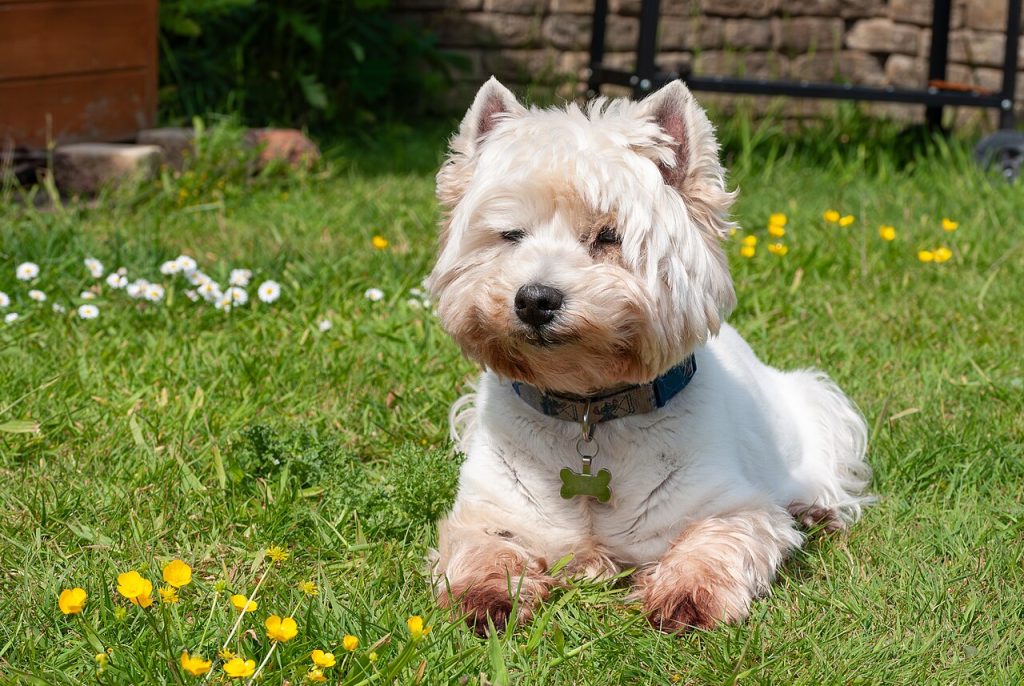
Image: West Highland White Terrier lying on lawn May 2023, Dominic Nelson, CC BY-SA 4.0, via Wikimedia Commons.