Editorial update · Updated October 23, 2026. This page has been rewritten; historical models and events are identified in the text.
Two metal bars near the middle of a rear seat do not necessarily form a pair for a center car-seat installation. They may be the inner anchors of the two outboard seating positions. Using them together is often called borrowing lower anchors, and it requires checking both the vehicle and child-restraint instructions.
Start with the vehicle’s seating-position diagram
Find the diagram for the actual model year, row and seat configuration. Identify which two anchors belong to each approved lower-anchor installation. Some vehicles provide a dedicated center pair; others permit a specified shared arrangement or do not allow center borrowing at all. Counting the total number of bars cannot tell you which arrangement applies.
Look for restrictions involving adjacent seats, a split-folding bench, seat adjustment or access to belt buckles. If the center arrangement uses an anchor otherwise assigned to an outboard position, that can affect what may be installed alongside it. Do not attach two restraints to the same anchor.
Then check the restraint manufacturer’s permission
A vehicle can allow a particular center arrangement while the child restraint does not. Borrowed anchors may have different spacing from a standard pair, and the restraint manufacturer determines which spacing and configurations its product permits. Flexible lower-anchor straps and rigid attachments can have different requirements; the ability to stretch a strap between two points does not establish approval.
IIHS’s explanation of LATCH specifically advises checking both the vehicle’s permission and the child-seat instructions. Ford’s linked example also shows why actual spacing matters, but its measurements are not a guide for another vehicle. Use the manual matching the car in front of you.
If either manual is silent or unclear, contact that manufacturer with the model details and intended configuration. Do not treat the absence of a warning in a shortened online listing as permission.
The center seat belt may be the appropriate alternative
Where both manuals allow it, a vehicle-belt installation can secure a restraint in a center position without borrowing lower anchors. Follow the required belt path, locking method and buckle setup. Some center belts have an additional connector or storage arrangement; assemble them exactly as the vehicle manual directs.
For forward-facing harnessed use, identify and use the designated top-tether anchor according to the instructions. The presence or absence of a center lower-anchor pair does not by itself answer where a top tether may attach. A tether assigned to another seating position is not automatically available to borrow.
Evaluate the finished arrangement with neighboring occupants
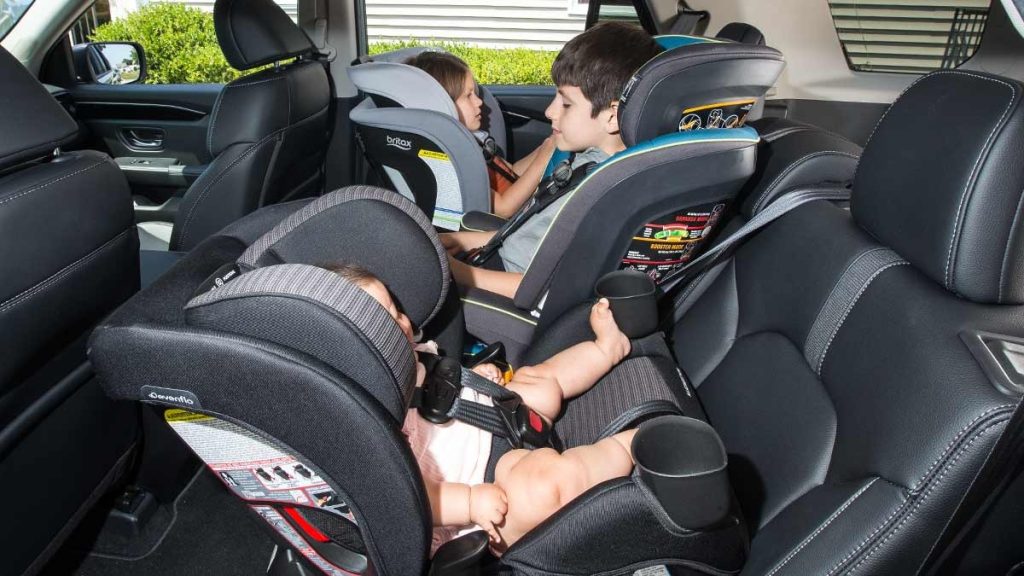
Check the required installation tightness at the belt path and any rules about support or contact with other seats. Make sure a neighboring passenger can buckle properly and that another restraint does not conceal an invalid installation. A seat that seems stable only because it is wedged tightly between two others needs its own installation evaluated.
Do not shift a restraint away from its prescribed anchor alignment merely to make three seats fit. A different approved installation method, different restraint combination or another seating arrangement may be necessary. Every child and passenger needs a valid position at the same time.
Revisit the choice when the child grows
Lower-anchor weight limits apply even when borrowing is permitted. Check the instructions for when to change to a seat-belt installation and continue the required tether use. That change concerns the attachment method; it does not automatically mean the child has outgrown the harness.
For related questions, review why generic LATCH retrofit kits are not a solution, installation troubleshooting and how to prepare for a car seat check. Bring the exact vehicle and restraint details so the answer can address the specific configuration.