A shop tells you the AC compressor has failed and the repair will run well over $1,000. The car is twelve years old and worth maybe $4,000, and the AC has been weak since June. Is it worth fixing, or should you just drive with the windows down?
Either answer can be right. What decides it is not the quote alone. It comes down to what actually failed, what the failure did to the rest of the system, and how long you plan to keep the car. Here is how to work through each one before you approve anything.
Make sure it is the compressor
Compressors take the blame for plenty of problems they did not cause, and a few cheap checks can save the whole repair.
Start with refrigerant. Most systems have a low-pressure switch that keeps the compressor from engaging when the charge is too low, because a system short on refrigerant is also short on the oil that travels with it. A clutch that never clicks on is therefore often a leak problem rather than a dead compressor. A blown fuse, a failed relay or a faulty pressure switch can produce the same symptom for a few dollars in parts.
The pattern of symptoms helps too. On a dual-zone system, one side blowing cold while the other blows warm suggests a marginal refrigerant charge or a stuck blend door actuator, since a dead compressor would take cooling away from both sides. Air that is cold at highway speed but warm at idle usually points to a condenser fan or a low charge before it points to the compressor.
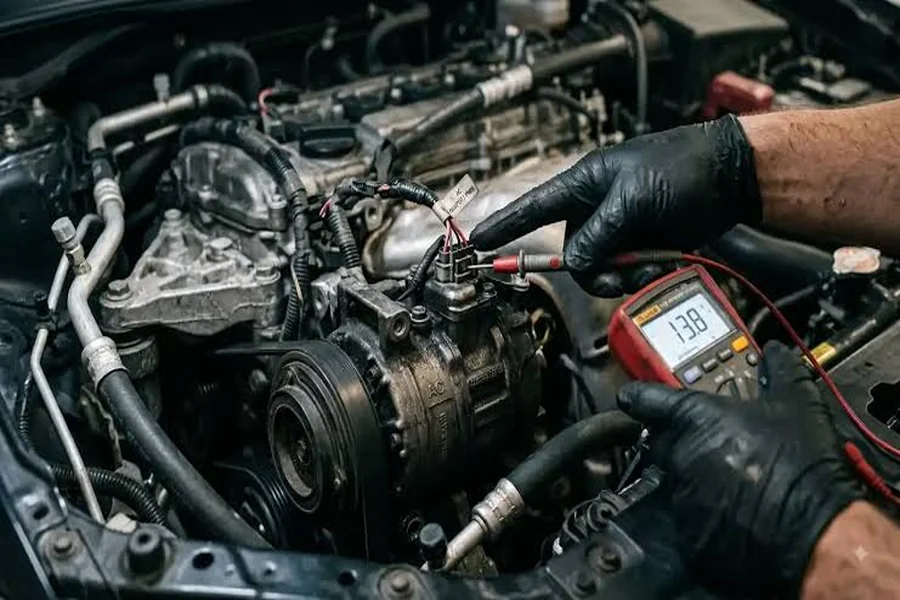
You can also watch the compressor itself. With the engine running and the AC on, the outer pulley always spins with the belt. The center plate, called the clutch hub, should lock on and spin with it a few seconds after you press the button, then cycle off and on. If the hub never moves, a technician can feed 12 volts straight to the clutch coil. If it engages, the clutch is fine and the fault is upstream, in a relay, a switch or the control module. If the hub spins but the air stays warm, gauges settle it: high-side and low-side pressures that barely differ while the compressor runs mean the pump is not compressing.
Finally, ask why it failed. Compressors rarely die of age alone. Many fail because a leak let refrigerant and oil escape and the unit ran starved. A UV dye leak check costs little next to a compressor, and skipping it is how people end up paying for the same repair twice.
What a failed compressor does to the rest of the system
Three kinds of failure get lumped together, and they lead to very different bills.
A failed clutch coil or a leaking shaft seal is contained. The compressor’s internals are fine and nothing foreign is circulating through the lines.
An internal failure is a different story. When bearings, pistons or vanes wear out, or the unit seizes, metal particles travel through the whole system. Technicians call the result “black death” because of the dark, gritty sludge it leaves behind. The debris clogs the orifice tube or expansion valve, saturates the drier or accumulator, and lodges in the condenser. Many newer cars use parallel-flow condensers with very narrow passages that cannot be flushed clean, so the condenser has to be replaced as well.
This is why quotes for the same car can differ by $600 or more. Ask the shop one question: did the old compressor fail internally, and did you find debris? If the answer is yes and the quote covers only a compressor and a recharge, the new unit is likely to be damaged by what was left behind, and most compressor warranties will not cover that.
Option one: repair what is actually broken
Repair makes sense when the compressor is healthy and a smaller part has failed. The usual candidates are a clutch coil, a relay, a pressure switch, or a leaking O-ring or service valve.
Clutch-only repairs deserve a careful comparison. A clutch kit costs far less than a compressor, and on many vehicles it can be swapped with the compressor still on the car. But labor can run nearly as long as a full replacement, and a worn clutch often belongs to a compressor with plenty of hours on it. If the two quotes sit within a couple of hundred dollars of each other, a full replacement usually buys more remaining life.
Option two: replace it, and choose the part with care
A replacement can be new from the dealer, new aftermarket, remanufactured, or used OEM. Each trades cost, fit and warranty differently.
A new dealer part is the most expensive and usually carries the longest warranty. New aftermarket units vary widely in quality, and mismatches in pulley type, clutch connector or mounting points are common enough that you should compare the part against your old one before installation. Remanufactured units are rebuilt cores, and the result depends entirely on who rebuilt them. A used OEM compressor pulled from a donor car is the same factory part your car came with, so fitment is usually exact and the price is typically a fraction of new. The tradeoff is a shorter warranty and an unknown history.
For an older car, that last option is often the sensible one, especially when a model’s compressors are no longer in production. A used AC compressor from a low-mileage donor can cut the parts bill by several hundred dollars. Labor is the same either way, so the part price is where a used-part repair saves money.
If you go used, a few details matter more than the price.
Match by VIN, not just year and model. The same model can carry different compressors depending on engine, rear AC and production date, and even the pulley groove count and electrical connector can differ.
Ask what is included. The clutch, pulley and coil should be attached, and you should hear how the unit was tested.
Ask about oil. A compressor holds oil that is part of the system’s total charge. Have the installer drain and measure the oil from the old unit and the replacement, then add the amount the manufacturer specifies for the whole system. Too much oil cuts cooling and can damage the compressor, and too little starves it. The type matters as well: PAG oil is typical on R-134a systems, R-1234yf systems call for oil specified for that refrigerant, and hybrid electric compressors use POE oil, whose electrical insulating properties are part of the safety design. Do not mix them.
Read the warranty. Check its length, whether labor is covered (often it is not), and what proof it requires, such as a receipt showing the drier and expansion device were replaced. A seller of used auto parts online should be able to answer all of this before you pay. If they cannot, that tells you something.
Option three: live without it
Skipping the repair is a legitimate choice, but it has costs that are easy to underestimate.
Start with defrost. On many cars the defrost setting runs the compressor, because dry air clears fog faster. With a dead compressor, windshield fog in damp or cold weather can get noticeably worse. That is a safety issue, not a comfort issue, so test your defrost before deciding.
Then consider the belt. If only the clutch has failed, the pulley spins freely and nothing else is affected. But if the pulley bearing is the failing part, a seized compressor can shred the serpentine belt, which usually also drives the alternator and often the water pump or power steering. Ask a mechanic to spin the pulley by hand. A rough or noisy bearing is not something to leave in place. For many popular models, a bypass pulley or a shorter belt lets you take the compressor out of the loop entirely.
Hybrids and EVs add another wrinkle. Some use the AC loop to cool the high-voltage battery, so a dead compressor can limit power or charging speed along with cabin comfort. Check before you skip the repair.
Climate and resale matter too. In a mild climate, a car without working AC loses less value than the same car in Arizona or Florida, where many buyers will not consider it. If you plan to sell within a year or two, working AC makes the car easier to move in a hot market, though you rarely get the full repair cost back in the price.
Doing the math
A rough rule of thumb, not an industry standard: if the total repair is under about a quarter of the car’s value, it is usually worth doing if you will keep the car another couple of years. Between a quarter and a half, it depends on your climate and how long you will hold on to it. Above half, fix it only if the car is otherwise in very good shape.
Here is an illustration with round numbers. A car worth $4,000 and a $1,400 quote using a new compressor puts the repair at 35 percent of value. The same job with a used OEM compressor might come to about $1,000, or 25 percent. Same labor, same cold air at the vents, but the second number moves the decision from “think hard about it” to “reasonable.”
Refrigerant can shift the numbers as well. R-1234yf, used in many cars since around 2015, costs several times as much per pound as R-134a, so a recharge on a newer car is a bigger line item. At the other end, cars built before the mid-1990s used R-12, which is scarce and expensive, so the usual route is a retrofit to R-134a that needs a new drier and the right oil.
Helping the new compressor survive
Most replacement compressors that fail early were let down by the installation, not the part. Insist on a new drier or accumulator, since the old one is saturated with moisture once the system has been opened. Ask for a new orifice tube or expansion valve. If the old compressor failed internally, the lines and condenser need to be flushed, or the condenser replaced if it cannot be flushed. The system should be held under vacuum for at least half an hour to boil off moisture, and the refrigerant should be charged by weight, not by guesswork.
Also confirm the root cause is fixed. A leak, a dead condenser fan or a clogged condenser can all make a compressor run hot and starve for oil, and a new unit will meet the same fate.
Avoid DIY recharge cans that contain stop-leak sealant. The sealant can clog the system’s narrow passages, and some shops add a fee or refuse to service a system once it has been used.
A quick decision guide
- If it is a fuse, relay or pressure switch fault, repair it. It is cheap and quick.
- If it is a small leak at an O-ring or service valve, fix the leak, then recharge.
- If the clutch coil failed but the compressor internals are fine, compare a clutch kit against a full replacement.
- If the compressor failed internally with debris in the system, replace the compressor, drier and expansion device, and flush or replace the condenser.
- If the car is worth little and you are selling soon, skip the repair, but check defrost and the pulley first.
Taken apart, an AC quote is a handful of smaller decisions. Find out whether the damage stayed inside the compressor, price the part options separately, and weigh the total against what you will actually get from the car. That usually points to an answer faster than the first estimate did.