Six hundred dollars. That’s what a Denver driver paid a dealership for an oil change, a cabin filter, and a “multi-point inspection” that mostly consisted of a clipboard. The car didn’t need anything else. That number is why so many Audi owners start asking about the benefits of a local Audi repair shop before the factory warranty has even expired.
Here’s the honest version of that story. The dealership isn’t evil, and the independent European shop down the street isn’t automatically a saint. Both can do good work. But the economics and the incentives point in very different directions, and once you see how the money flows, the choice for routine maintenance gets a lot less complicated.
I’ll walk you through where the margin hides, what actually keeps your warranty intact, and a checklist you can run before handing your keys to anyone. You’ll also see the two or three situations where the dealership genuinely wins, because pretending otherwise would waste your money in a different direction.
Where the dealership’s money actually comes from
Dealers make most of their profit after the sale, not from the car itself. Service bays, parts counters, and finance offices carry the building. That’s not a conspiracy, it’s a business model, and it means the person writing your service ticket has a target to hit each month. Some of them hit it honestly. Some recommend a fuel induction service on a car with 12,000 miles.
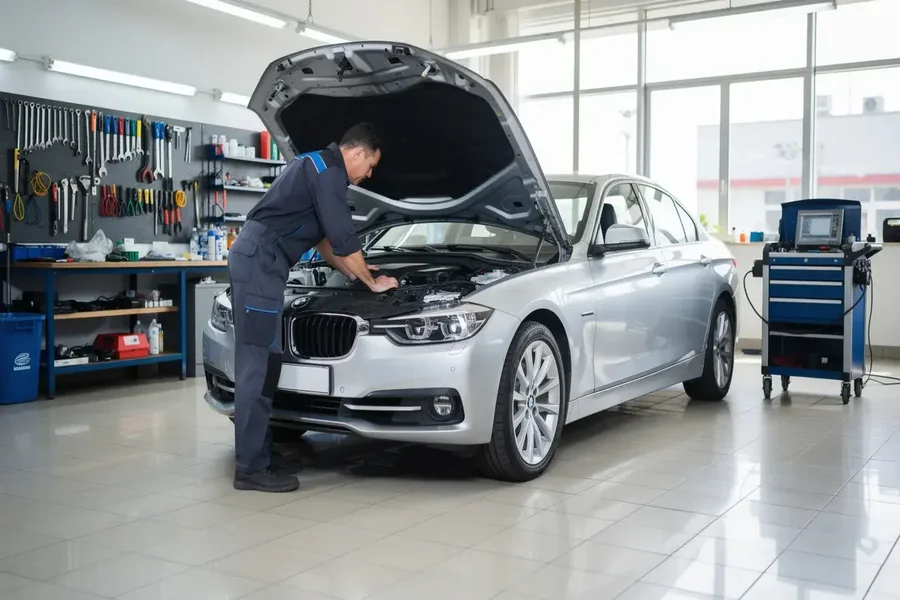
An independent shop like Paddock Imports runs on a thinner machine. Fewer loaner cars, no glass showroom, no salespeople pacing the floor. The trade-off is that the diagnostic tech who has pulled a thousand Audi valve covers is often the same person who talks to you about the car. You get a phone call from the guy with grease under his nails instead of a service advisor reading from a screen.
That distinction sounds soft until you’ve lived through a mystery noise. “We couldn’t replicate it” is a very different sentence coming from someone who spent eight years on VW Group platforms than from a general shop that pulls up YouTube when your S4 rolls in.
What the warranty rules really say
This is the fear that keeps people locked to dealers, and it’s mostly misplaced. In the United States, the Magnuson-Moss Warranty Act prevents manufacturers from voiding your warranty simply because an independent shop did the work. The Federal Trade Commission enforces those consumer protection rules, and the short version is that the automaker has to prove the third-party work caused the failure before denying a claim.
Where people get burned is documentation, not location. Keep every invoice. Make sure the shop logs the correct spec oil and filters. If your independent tech used a generic filter and the receipt says “oil change, $39,” you’ve handed Audi a gift. A shop that specializes in imports knows to write down the OE part numbers and the exact fluid specs, which is what protects you if a turbo or a timing chain lets go at 40,000 miles.
My take: mechanical repairs at a specialty shop, documented properly, are safe. Warranty-covered software updates, recall campaigns, and anything the factory is paying for should go to the dealer, because it’s free and they have the diagnostic interface. Don’t overthink that part.
Diagnostics are where the gap shows up
Modern Audis are rolling networks. A B9 A4 has dozens of control modules talking to each other over a CAN bus, and a misfire code doesn’t mean “replace the coil.” It means you need someone who can read live data, understand what the ECU is trying to do, and know which of four likely causes matches the freeze-frame.
Dealership techs get factory training. So do the good independents, just through a different path and usually on their own dime. The Bureau of Labor Statistics tracks automotive service technicians as a sizable occupation, and the ones who specialize in a single brand tend to stay in that lane for their whole career. Repetition builds pattern recognition you can’t buy from a scan tool.
A concrete example. An A6 comes in with an intermittent EPC light and a rough idle after cold starts. A general shop reads the code, sees a camshaft position fault, and quotes a sensor. The European specialist knows that on that engine family, a stretched timing chain tensioner produces the same code and a similar symptom, and that replacing the sensor alone buys you three months. That’s a $2,000 difference in outcome from a $120 diagnostic fee. Worth thinking about.
The cost of waiting for parts
Here’s a section that gets skipped in a lot of “dealer vs independent” pieces. Time.
A general repair garage ordering an Audi-specific part usually goes through the same supply chain as everyone else, but without the relationships. No standing account with the local dealer parts desk, no specialty importer who keeps tensioners and water pumps on a shelf. Your car sits on a lift while someone makes phone calls.
A shop that only sees German cars has a parts rhythm. They know which components fail on which platforms around which mileage. Water pumps on certain 2.0T generations. Thermostat housings. Rear main seals. They keep some of it in stock and know exactly who can deliver the rest by 10 a.m.
Then there’s the shop floor itself. Your Department of Energy has nothing to do with your brake rotors, but the efficiency logic holds for a service bay: a tighter operation wastes fewer hours on the same job. Fewer wasted hours, lower invoice. That’s the whole mechanism, and it’s why a specialty shop often beats a dealer on labor even when the hourly rate looks similar on paper.
Before you hand over the keys
Run this the first time you try any shop. It takes ten minutes and saves you from the version of this decision that goes wrong.
- Ask what diagnostic software they run. VCDS or an equivalent factory-level tool means they can read and code modules. A generic OBD2 reader is fine for a check engine light and useless for everything else.
- Get the fluid spec in writing. Audi transmissions and transfer cases are picky. If the invoice says “ATF” and nothing else, ask a follow-up question.
- Walk the lot. Porsche, BMW, and VW badges are a good sign. A bay full of Audis is a better one.
- Ask who actually touches your car. One named tech, or whoever is free? You want the first answer.
- Confirm they’ll document OE part numbers. This is your warranty shield, as covered earlier.
If a shop dodges any of those, walk. Plenty of good ones will answer in thirty seconds flat.
When the dealership is the right call
I said I’d be fair, so here it is. Lease returns and factory-paid recall work go to the dealer. So does any repair where you’re still inside a warranty and want zero argument if it fails. And if your Audi is a brand-new RS model, the dealer’s factory tooling and direct line to Audi technical support is genuinely the fast path for a strange fault.
Everything else, from the 40,000-mile fluid service to the suspension clunk to the pre-purchase inspection on a used S3, an independent European shop wins on price, on time, and usually on whether they can explain what’s actually wrong with your car in plain English.
The decision, in one line
You bought the car because it’s good to drive. The shop that keeps it that way should be the one that sees your platform every week, not every third Tuesday. Find your independent European specialist, run the checklist once, and keep the receipts.
One question worth sitting with: if your current shop can’t tell you which generation of engine is under your hood, what exactly are you paying them for?