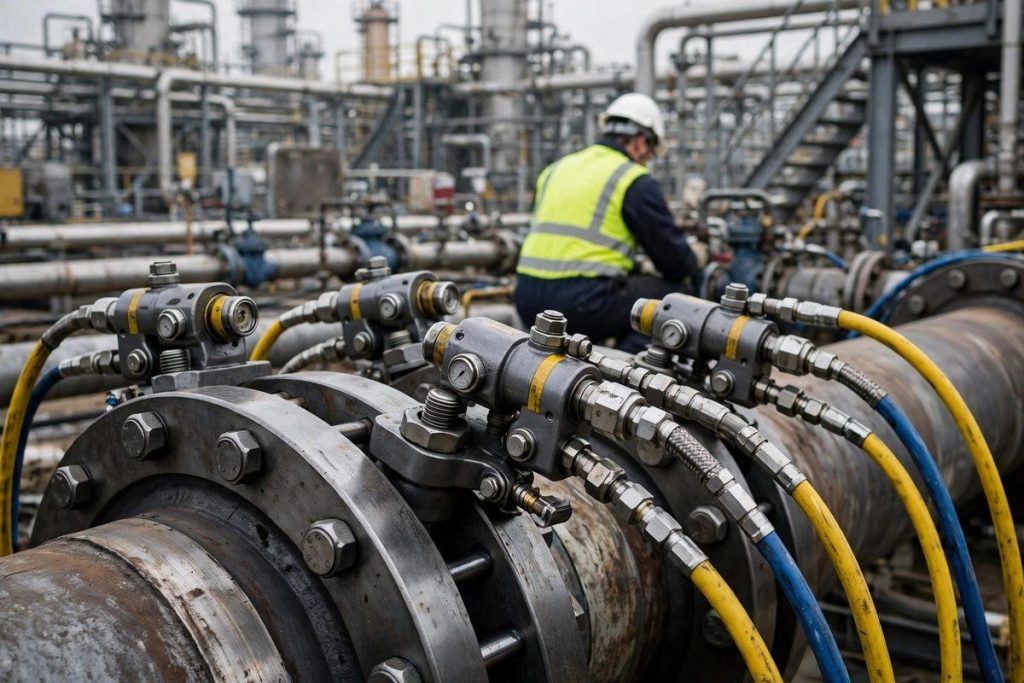
A hydraulic bolt tensioner stretches a bolt directly with hydraulic pressure, so the bolt holds an exact clamping force without the guesswork of turning a nut. It gives engineers a far more accurate preload than a torque wrench, which is why it is the standard choice for joints where a leak or a failure could be dangerous. In short, tensioning controls the load in the bolt itself, not the effort used to turn the nut.
Every bolted joint works the same way at its core. Tightening a bolt stretches it a tiny amount, like a spring, and that stretch pulls the parts together. The clamping force this creates is called preload — yet most tightening methods never measure it at all.
What a Hydraulic Bolt Tensioner Does
A hydraulic bolt tensioner is a tool that fits over the end of a stud and pulls it straight, using high-pressure oil. There is no turning, no twisting, and no reliance on friction. The bolt is stretched to a set load, the nut is run down by hand, and the pressure is released. The bolt tries to shorten again, but the nut holds it in place, so the load stays locked in.
Think of the bolt as a spring. A torque wrench stretches it by turning the nut, which drags against the threads all the way. A tensioner pulls it straight from the end, giving a cleaner, more repeatable load.
Tensioners are made for bolts from 0.2 inches in diameter up to 20 inches, and need at least one bolt diameter of free thread above the nut to grip.
How Hydraulic Tensioning Works
The process follows the same short sequence on every joint:
- Fit the tensioner. The tool sits over the stud, above the nut, and a bridge takes the load against the flange face.
- Apply hydraulic pressure. A pump drives oil into the cylinder, often at 16,000 to 22,000 psi. The cylinder pulls the stud upward and stretches it.
- Run the nut down. While the bolt is stretched, the nut is turned down by hand until it sits flat.
- Release the pressure. The pressure is let off slowly. The bolt contracts and the load transfers onto the nut.
- Check the result. On critical joints, engineers verify the load with a gauge reading, a measured stretch, or an ultrasonic check.
Engineers call this five-step sequence the hydraulic bolt tensioning procedure, and they pair it with hydraulic bolt tensioning calculations that set the pressure for the load each joint needs.
One detail matters here. A small amount of load is always lost when the pressure comes off, as the nut and joint settle. Good bolting plans allow for this release loss, so the final load still lands in the target range.
Tensioning Compared With Torque Tightening
Torque tightening is the method most people know: a wrench turns the nut, and a torque value is read off the tool. It is simple, cheap, and fine for everyday joints. The problem is friction. Studies show roughly 85 to 90 per cent of applied torque is lost to friction in the threads and under the nut face, and only about 10 per cent stretches the bolt. That friction is also inconsistent — a little more oil or a rougher surface can change the result by a wide margin.
In normal field conditions, torque tightening typically lands within about ±25 to 30 per cent of the target preload. Hydraulic tensioning usually achieves around ±5 to 10 per cent, because it bypasses friction almost entirely.
Here is how the two methods compare in practice:
- What is measured: torque measures turning effort; tensioning measures the load in the bolt.
- Friction effect: torque results swing with lubrication and surface condition; tensioning results stay steady.
- Twisting stress: turning a nut twists the bolt; tensioning stretches it straight, so there is no torsional stress and far less risk of thread galling.
- Speed on big flanges: torque tightens one bolt at a time; several tensioners can run from one pump, so a whole flange can be loaded at once.
- Best fit: torque suits routine, low-risk joints; tensioning suits large or safety-critical joints.
Standards such as ASME PCC-1 and EN 1591-4 cover controlled tightening for pressure joints, and the German guideline VDI 2230 ranks methods by preload scatter, with hydraulic tensioning well ahead of torque.
Why Preload Accuracy Matters
Getting bolt preload right decides whether a joint holds, leaks, or fails.
- Too little preload lets a joint open under pressure or vibration. Gaskets lose their seal, fluids leak, and bolts work loose over time.
- Too much preload stretches the bolt past its safe limit. It can yield, crack, or break, often without warning.
- Uneven preload squeezes the gasket harder on one side of a flange, a common cause of leaks on large pipe flanges.
- Fatigue life drops fast when preload is wrong. A well-preloaded joint shares the load, so the bolt sees only a small part of each load cycle.
Where Bolt Tensioners Are Used
Tensioners are used wherever a bolted joint carries high pressure, heavy loads, or serious safety consequences:
- Oil and gas: pipeline flanges, wellheads, blowout preventers, and subsea connectors.
- Power generation: steam turbine casings, generator end bells, and heat exchanger joints.
- Wind energy: tower flange bolts and foundation anchor bolts, including very large bolts above M48.
- Pressure vessels and heat exchangers: large flanges that must stay sealed under high internal pressure.
- Heavy industry: mining equipment, cranes, presses, and structural steel connections.
- Transport: diesel engine cylinder heads, and the bolts that hold aircraft wings to the fuselage.
The technology dates back to the 1940s and became widely used in the 1970s.
Limits to Keep in Mind
Tensioning is not the answer for every joint.
- Space: the tool needs clear room above and around each bolt, which tight assemblies may not have.
- Thread length: the stud must stick out far enough above the nut for the tensioner to grip.
- Cost: tensioners and pumps cost more than a torque wrench, so they pay off mainly on large or critical joints.
- Training: operators need to understand pressure settings, release loss, and safe handling of high-pressure oil.
The rule is simple: if the cost of a leak or a failure is high, the extra control of tensioning is worth it. To see how these tools are built and which sizes are available, you can read more on the official site.
Frequently Asked Questions
How accurate is hydraulic bolt tensioning?
Usually around ±5 to 10 per cent, compared with about ±25 to 30 per cent for torque tightening in field conditions.
Why is torque tightening less accurate?
About 85 to 90 per cent of applied torque is lost to friction, and that friction changes with lubrication and surface condition.
Can several bolts be tensioned at the same time?
Yes. Multiple tensioners can run from one pump, so a whole flange can be loaded evenly at once. Large systems have tightened 27 bolts at the same time.
Does tensioning damage the bolt?
No. It stretches the bolt within its elastic range and avoids the twisting stress and thread galling that torque tightening can cause.
What is a hydraulic bolt tensioner?
A tool that stretches a bolt with hydraulic pressure instead of turning the nut, giving a more accurate, even load.
How does a hydraulic bolt tensioner work?
It pulls the stud straight with high-pressure oil while the nut is run down by hand, then releases the pressure so the load locks in. That pull-and-release cycle is the working principle of every tensioner.
Can I hire a tensioner for one job?
Yes. Hydraulic bolt tensioner rental is common for shutdowns; just check the tensioner dimensions and the free thread above the nut first, so the tool fits your bolts.
Conclusion
Hydraulic bolt tensioners give engineers direct control over preload — the one thing that matters in a bolted joint. By stretching the bolt with hydraulic pressure instead of turning the nut against friction, they deliver a tighter, more even clamping force, and that accuracy keeps critical joints sealed and safe.